RBAC vs ABAC in Kubernetes: Why ABAC Is Dead and What to Use Instead
Quick answer
Kubernetes supports both RBAC and ABAC — but ABAC has been effectively deprecated since 1.8. If you're searching for RBAC vs ABAC, here's what you actually need to know, and what to use when RBAC isn't expressive enough.
- How RBAC Works
- How ABAC Works (and Why It's Dead)
- Where RBAC Falls Short
- What to Use When RBAC Isn't Enough
- The Practical Layered Model
10 min read · Kubernetes
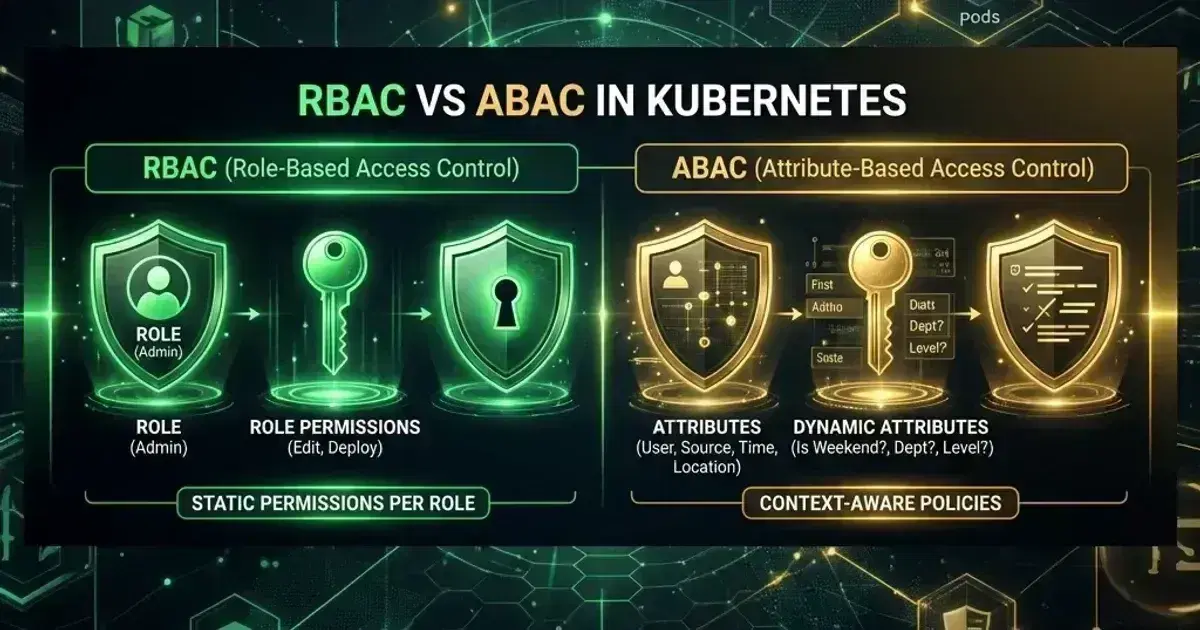
Kubernetes supports two built-in authorization modes for controlling API access: RBAC and ABAC. If you're comparing them expecting a real trade-off analysis, the answer is short: use RBAC, don't use ABAC.
ABAC was Kubernetes' original authorization mechanism. It predates RBAC and has been effectively superseded since Kubernetes 1.8 when RBAC became stable. Most production clusters running today have never had ABAC enabled. The reason it still shows up in search results is that the Kubernetes API server technically still supports it — but it's not something you should be evaluating for new deployments.
The more interesting question, which is probably what brought you here, is: what do you use when RBAC isn't expressive enough? That's where this post actually goes.
How RBAC Works
Kubernetes RBAC (Role-Based Access Control) controls access to API resources through four object types:
- Role — grants permissions within a single namespace
- ClusterRole — grants permissions cluster-wide or can be bound within a namespace
- RoleBinding — binds a Role (or ClusterRole) to a subject within a namespace
- ClusterRoleBinding — binds a ClusterRole to a subject cluster-wide
Subjects are users, groups, or service accounts. Rules define which verbs (get, list, watch, create, update, patch, delete) are allowed on which API resources in which API groups.
1apiVersion: rbac.authorization.k8s.io/v1
2kind: Role
3metadata:
4  name: pod-reader
5  namespace: production
6rules:
7  - apiGroups: [""]
8    resources: ["pods"]
9    verbs: ["get", "list", "watch"]
10---
11apiVersion: rbac.authorization.k8s.io/v1
12kind: RoleBinding
13metadata:
14  name: read-pods
15  namespace: production
16subjects:
17  - kind: ServiceAccount
18    name: monitoring-agent
19    namespace: production
20roleRef:
21  kind: Role
22  name: pod-reader
23  apiGroup: rbac.authorization.k8s.io
RBAC is additive — there are no deny rules, only grants. A subject has access to a resource if any binding grants it. If no binding grants it, access is denied by default.
This model is simple, auditable, and well-supported by tooling (kubectl auth can-i, rbac-lookup, audit2rbac). It works well for the majority of access control requirements.
How ABAC Works (and Why It's Dead)
ABAC (Attribute-Based Access Control) in Kubernetes works through a policy file on the API server — a JSON file where each line is a policy object:
{"apiVersion": "abac.authorization.kubernetes.io/v1beta1", "kind": "Policy", "spec": {"user": "ajeet", "namespace": "production", "resource": "pods", "readonly": true}}To add, change, or remove a policy, you edit that file and restart the API server. On a managed cluster (EKS, GKE, AKS), you cannot restart the API server. On a self-managed cluster, restarting the API server causes a brief API unavailability.
That operational model — file-based policy with API server restart required — is why ABAC was abandoned. It doesn't scale, it's not auditable through Kubernetes-native tooling, and it can't be updated dynamically. RBAC replaced it precisely because RBAC policies are stored as Kubernetes objects and can be created, updated, and deleted via the API without any control plane disruption.
The bottom line: If you're running a modern Kubernetes cluster, ABAC is not a consideration. Enable RBAC, leave ABAC disabled, and move on.
Where RBAC Falls Short
RBAC is expressive enough for most teams. But it has real limitations:
It can't express contextual conditions. RBAC can say "this service account can read secrets in namespace A." It cannot say "this service account can read secrets in namespace A, but only if the secret has label env=production." There's no field selector or label selector in RBAC rules.
It can't enforce resource constraints. RBAC can say "this team can create Deployments." It can't say "this team can create Deployments, but only if they specify resource requests and limits." That's a policy concern, not an authorization concern.
It can't express time-based or IP-based access. RBAC has no concept of "allow access between 9am–6pm" or "deny requests from outside this CIDR." Those are handled at the network layer or by an admission webhook, not by RBAC.
ClusterRoles accumulate over time. As teams add permissions, ClusterRoles grow. Auditing what a given service account can actually do across all bindings becomes difficult at scale.
These gaps are why policy engines exist alongside RBAC, not instead of it.
Kubernetes Production Readiness Checklist
The pre-launch checks we run before calling a cluster production-ready — probes, resources, RBAC, upgrades, and backups. Plain Markdown you can commit to your repo.
Free. Instant download. You'll also get the occasional deep-dive from the newsletter — unsubscribe anytime.
What to Use When RBAC Isn't Enough
OPA / Gatekeeper
OPA (Open Policy Agent) with Gatekeeper is the CNCF-graduated policy engine for Kubernetes. Gatekeeper runs as a validating admission webhook and evaluates Rego policies against admission requests before they're persisted to etcd.
OPA/Gatekeeper can enforce:
- All containers must have resource limits
- Images must come from an approved registry
- Services of type LoadBalancer are not allowed in non-production namespaces
- Labels
teamandenvare required on all Deployments
Gatekeeper uses two CRDs: ConstraintTemplate (defines the Rego policy) and Constraint (instantiates it with parameters). The learning curve for Rego is real — it's a logic language that takes time to get comfortable with.
Kyverno
Kyverno is a Kubernetes-native policy engine that uses YAML policies instead of Rego. For teams without a background in policy languages, Kyverno is significantly easier to get started with.
1apiVersion: kyverno.io/v1
2kind: ClusterPolicy
3metadata:
4  name: require-resource-limits
5spec:
6  rules:
7    - name: check-container-resources
8      match:
9        any:
10          - resources:
11              kinds: ["Pod"]
12      validate:
13        message: "Resource limits are required."
14        pattern:
15          spec:
16            containers:
17              - resources:
18                  limits:
19                    memory: "?*"
20                    cpu: "?*"
Kyverno can validate, mutate, and generate resources. It's a CNCF incubating project with strong adoption. For most teams, Kyverno is easier to operate than OPA/Gatekeeper unless you already have Rego expertise.
RBAC + Namespace Isolation
Before reaching for a policy engine, consider whether stricter namespace isolation solves the problem. Many "RBAC isn't expressive enough" problems are actually namespace design problems. If each team has its own namespace with its own RoleBindings, scope is limited by construction — no cross-namespace access unless explicitly granted via ClusterRoleBinding.
Combined with LimitRange and ResourceQuota objects at the namespace level, you get resource enforcement without a policy engine. This is often the right starting point before adding OPA or Kyverno.
The Practical Layered Model
These tools are not mutually exclusive. Production clusters typically run:
- RBAC — who can call which Kubernetes API
- Network policies — which pods can communicate with which pods
- Pod Security Admission (or OPA/Kyverno) — what constraints apply to workload specs
- Audit logging — record all API calls for compliance and incident response
ABAC fits nowhere in this model. The attribute-based access control concept is real and valuable — it just isn't implemented via Kubernetes' native ABAC mode. It's implemented through admission webhooks (OPA, Kyverno) that can evaluate arbitrary attributes of the incoming request.
Enabling RBAC (and Disabling ABAC)
On most managed clusters today, RBAC is enabled by default and ABAC is not available. On self-managed clusters:
kube-apiserver \
  --authorization-mode=Node,RBAC \
  ...
Node authorization is required for kubelets. RBAC handles everything else. Do not add ABAC to --authorization-mode unless you have a specific legacy reason — and even then, migrate off it.
Verify what's enabled on your cluster:
kubectl get pod kube-apiserver-<node> -n kube-system -o yaml | grep authorization-modeSee also
Frequently Asked Questions
Is ABAC still supported in Kubernetes?
Technically yes — the ABAC authorizer still exists in the API server binary. But it's not documented as a recommended mode, requires API server restart for policy changes, and no managed Kubernetes provider enables it. Treat it as a legacy artifact, not a viable option.
Can I use RBAC and OPA/Kyverno together?
Yes, and you should. RBAC handles API authorization (which verbs on which resources). OPA/Kyverno handle admission control (what the resource spec is allowed to look like). They operate at different points in the request lifecycle and complement each other.
What replaced ABAC in practice?
RBAC replaced ABAC for API authorization. For the attribute-based use cases ABAC was meant to handle (contextual, label-based, conditional access), admission webhooks like OPA/Gatekeeper and Kyverno are the modern answer.
Is Kyverno or OPA better?
For most teams: Kyverno is easier to start with (YAML policies, no new language). OPA/Gatekeeper is more powerful for complex logic and is better if you already use OPA elsewhere (e.g., for infrastructure policy in Terraform via Conftest). Neither is universally better — pick based on your team's existing skills.
How do I audit what a service account can do?
kubectl auth can-i --list --as=system:serviceaccount:<namespace>:<name>This lists all permissions for a given service account. For a broader view across all service accounts, tools like rakkess and rbac-lookup provide more readable output.
For hands-on RBAC configuration in production, see Kubernetes RBAC in Practice: Least Privilege Without the Headache. For the misconfigurations that cause the most incidents, see RBAC Misconfigurations That Break Production.
Designing access control for a multi-team Kubernetes platform? Talk to us at Coding Protocols — we help platform teams build security models that are enforceable at scale.
Official References
- RBAC authorization — Role, ClusterRole and binding semantics
- Configure service accounts — token projection and the default service account
Was this article helpful?
Be the first to rate this article
Related Topics
Found this useful? Share it.